🔎 How to Check If Your Password Has Been Leaked (2026)
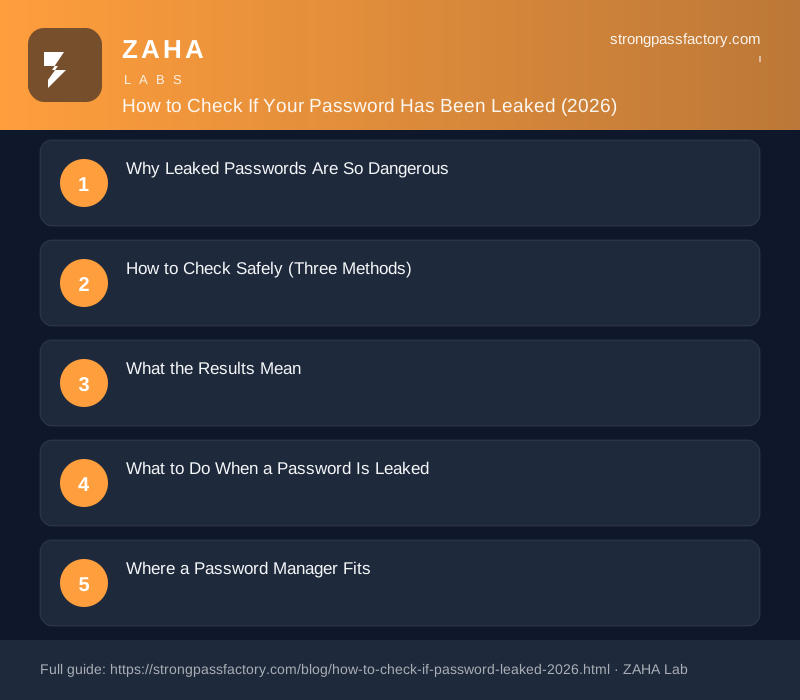
On this page
Checking whether your password has been leaked means comparing it against the billions of credentials exposed in past data breaches and posted to hacker forums. If a password you still use appears in one of those dumps, attackers already have it, and every account protected by it is one automated login attempt away from being taken over.
Data breaches are no longer rare events. Companies lose customer databases constantly, and the stolen email-and-password pairs get bundled into giant collections that circulate for years. The danger is not just the breached site itself. Because most people reuse passwords, one leaked login often unlocks a dozen other accounts. Knowing how to check whether your credentials are already exposed, and what to do next, is one of the highest-value security habits you can build. This guide walks through the safe ways to check, the tools worth trusting, and the steps that actually close the gap.
Why Leaked Passwords Are So Dangerous
When a website is breached, attackers rarely stop at that one site. They take the stolen list of emails and passwords and feed it into automated tools that try the same combinations across banking, email, and shopping sites. This attack is called credential stuffing, and it works precisely because password reuse is so common.
The scale is easy to underestimate. The FBI's Internet Crime Complaint Center reported that cybercrime losses have run into the tens of billions of dollars a year, with account compromise a leading driver. A single reused password sitting in an old breach corpus is enough to start that chain. That is why a password being merely strong is not enough: once it leaks, its strength no longer matters, because the attacker already has the exact string.
How to Check Safely (Three Methods)
There is a right way and a risky way to do this. The golden rule: check your email address freely, but be extremely cautious about typing an actual password into any website.
- Search your email at a breach-notification service. Have I Been Pwned, run by security researcher Troy Hunt, lets you enter an email address and see which known breaches included it. It stores no passwords in plain form and is widely trusted across the security industry. Enter each email you use and read the list of breaches it appears in.
- Use a password manager's built-in breach monitor. This is the method that scales. A good manager checks every password in your vault against known-leaked credentials and flags the exact accounts that need attention, without you pasting anything anywhere.
- Check passwords through a k-anonymity API, not a web form. Legitimate tools use a technique called k-anonymity: they hash your password, send only the first five characters of the hash, and check for matches locally. This means the service never sees your actual password. Password managers and browsers use this method behind the scenes.
What the Results Mean
| What you find | What it means | What to do |
|---|---|---|
| Email in a breach, old password | That login is public; reuse makes it dangerous | Change it anywhere you reused it |
| Email in many breaches | Your address is a known target for stuffing | Prioritise unique passwords and 2FA |
| A stored password flagged as leaked | The exact string is in a breach corpus | Replace it immediately with a random one |
| No results found | No known breach, but not a guarantee | Stay unique per site and keep monitoring |
A clean result is reassuring but not proof of safety. Breach-notification services only know about breaches that have been made public. Newer or quietly traded dumps may not be indexed yet, which is why continuous monitoring beats a one-time check.
What to Do When a Password Is Leaked
Finding a leaked credential is good news, not bad: it means you can act before an attacker does. Work through these steps in order.
- Change the password on the breached account first. Replace it with a long, random, unique password, not a small tweak of the old one.
- Change it everywhere you reused it. This is the step people skip and attackers count on. If the leaked password guarded five accounts, all five are exposed.
- Turn on two-factor authentication. Even if a password leaks again later, a second factor stops the login. The U.S. Cybersecurity and Infrastructure Security Agency (CISA) states that multi-factor authentication makes an account significantly harder to compromise, blocking the overwhelming majority of automated attacks.
- Stop reusing passwords for good. A password manager generates and stores a unique random password for every site, so one breach can never cascade into others.
Where a Password Manager Fits
Checking your email once tells you about the past. A password manager with breach monitoring protects you going forward, because it rescans your vault as new breaches surface and alerts you the moment a stored login appears in one. That turns a stressful annual chore into a quiet background service.
A tool such as NordPass includes a data-breach scanner that continuously checks your saved logins against leaked-credential databases, generates strong unique passwords to replace weak ones, and stores everything under zero-knowledge encryption so the provider never sees your vault. Because it flags the exact accounts at risk, you spend your effort fixing real problems instead of guessing which passwords to change. Pair that monitoring with unique passwords and two-factor authentication, and a future breach becomes a notification rather than an emergency.
Modern guidance reinforces this approach. NIST Special Publication 800-63B advises services to screen new passwords against lists of known-compromised credentials and to drop old rules like forced periodic resets, which pushed people toward predictable patterns. In other words, the official recommendation is exactly what a good breach monitor automates for you: check against what is already leaked, and make every password unique.
FAQs
Is it safe to enter my email into a breach checker?
Yes, entering an email address into a reputable service like Have I Been Pwned is safe. These tools check your address against known breach records and do not require or store your passwords. The caution applies to passwords, not email addresses: never type an active password into an unknown website, because you cannot verify what it does with the data.
How do password checkers work without seeing my password?
Trustworthy tools use a method called k-anonymity. Your password is hashed on your device, and only the first few characters of that hash are sent to the service, which returns all leaked hashes that start with the same prefix. The final match happens locally, so the service never receives your actual password. Password managers and major browsers use this technique for their breach warnings.
What should I do if my password appears in a breach?
Change it immediately on the affected account, then change it on every other account where you used the same password. Replace it with a long, random, unique password rather than a minor variation, and enable two-factor authentication so a future leak alone cannot unlock the account. A password manager makes all of this a few clicks instead of an afternoon of work.
Does a clean breach check mean my accounts are secure?
Not entirely. Breach-notification services only know about breaches that have become public, so a newer or privately traded leak may not appear yet. A clean result is a good sign, but the stronger protection is continuous monitoring plus unique passwords, so that even an unindexed breach cannot spread beyond the one account.
How often should I check for leaked passwords?
Check your main email addresses manually every three to six months, and rely on a password manager's breach monitor for daily coverage of your stored logins. Manual checks catch the big headline breaches, while automated monitoring catches the steady stream of smaller leaks that never make the news but still put your accounts at risk.